Callout process
What happens once something is reported
Every security firm promises a fast response. What that means in practice usually goes unsaid. Below is who does what, in which order, and within what timeframe, for each situation.
Four examples, one discipline
Whether a callout comes from a detector, a camera, from you, or from our own patrolling officer, the route underneath is the same each time. What differs is who sets it in motion and who makes the assessment.
- SignalSomething comes in
- AssessmentA person looks at it
- DispatchSomeone attends
- ActionResolved on site or escalated
- FeedbackYou hear what happened
The alarm goes off at your site
A detector triggers. From that moment a fixed route runs, from the signal through to a secured building and a message to you. This is what it looks like.
- At the moment itself
The alarm triggers
Control room
A detector at your site activates and transmits the signal. Nothing is required from you, including in the middle of the night.
- Within seconds
The signal arrives
Control room
It reaches the control room with the address, the type of detector and the zone involved. That immediately establishes whether this concerns an exterior door, an interior space or, for instance, fire.
- Typically within 2 minutes
Assessment and verification
Control room
The control room checks whether the signal fits what is normal for this address at this hour. Where cameras are available, the footage is pulled up. This already filters out a proportion of technical faults.
- Straight after the assessment
An officer is dispatched
Officer on site
The nearest officer receives the assignment with the site details and your specific arrangements: where the keys are, which entrance is used and who should be called.
- Typically 15 to 30 minutes after the call
Checks on site
Officer on site
First a circuit of the exterior: signs of forced entry, open doors or windows, damage to fencing. Where there is reason to, an interior round follows.
- As soon as the situation is clear
Escalation where needed
Police or fire service
In the case of a break-in, fire or somebody on the site, we alert the police or fire service and the officer stays until they arrive. You are called straight away in that case, not the following morning.
- The same night
Securing and feedback
You
Once the situation is safe, the premises are secured again. You then receive an account of what was found and what was done.
What you get out of itYou learn what was going on, what was done and whether anything is expected of you. If it turns out to have been a false alarm, you hear that just the same.
You see or hear something and call us
Not every call-out starts with a device. Sometimes you notice something yourself, or a member of staff or a neighbour calls you. You still do not have to go and look.
- At the moment itself
You call
You
The office number during the day, the 24-hour number outside office hours. You get a person, not a menu.
- First 1 to 2 minutes
Intake
Control room
We ask what exactly is going on: what you saw or heard, where, when, and whether anyone is present right now. Those questions may feel laborious, but they determine what gets sent.
- During the call itself
Establishing urgency
Control room
If people are in danger we call the emergency number first and everything else after. For a suspicious situation without immediate danger, an officer attends. If it can wait, we say so honestly and pick it up on the next round.
- Decided within minutes
Attendance or advice
Officer on site
Where it is needed an officer comes out. Sometimes no attendance is required but advice is, for example not to approach something yourself or not to disturb evidence.
- Typically on site within 30 minutes
Handling on site
Officer on site
The officer assesses the situation, deals with it where possible and alerts the emergency services where necessary. You are kept informed while it is running.
- The same day
Feedback and follow-up
You
Afterwards you hear what was found and done. If the call-out shows that something is structurally wrong, we come back to that separately.
What you get out of itSomeone has been out, acted where needed, and you know what was found. You did not have to attend yourself.
Our officer notices something during a patrol
Most findings do not come from an alarm but from an ordinary round. A door left open, a light that has failed, somebody who does not belong. This is what happens then.
- At varying hours, several times a night
The round is running
Officer on site
Our officer drives the route and passes your site at irregular hours. What is checked at each stop has been agreed with you in advance.
- During the round
Something stands out
Officer on site
A door that is normally closed is open, there is broken glass, the exterior lighting is out, or there is somebody on the site who should not be there.
- Immediately on site
Acting on the spot where possible
Officer on site
An open door is closed; an unauthorised person is challenged and removed from the site. Where a criminal offence is involved, the police are called and the officer remains present.
- Recorded within minutes
Recording it
Officer on site
The finding is logged with time, location and, where relevant, a photograph. That is not only for you: it is what you need towards an insurer or when reporting to the police.
- Urgent items at once, the rest in the night report
Reporting to you
You
Urgent matters are phoned through immediately. The rest is in the written feedback, so you know in the morning what happened overnight without having been woken for it.
- On the next round
Re-checked on the next round
Officer on site
Anything that could not be resolved on the spot, a broken lock for instance, goes on the list for the next round. A finding does not drop out of sight once it has been reported.
What you get out of itYou start the day with an account of what was found, instead of walking into it yourself. Anything that could not be resolved on the spot is listed with the follow-up action.
The observation unit on the construction site triggers
On construction sites and large yards we work with relocatable camera masts. They detect a great deal, and most of it is harmless. The skill is in telling the difference.
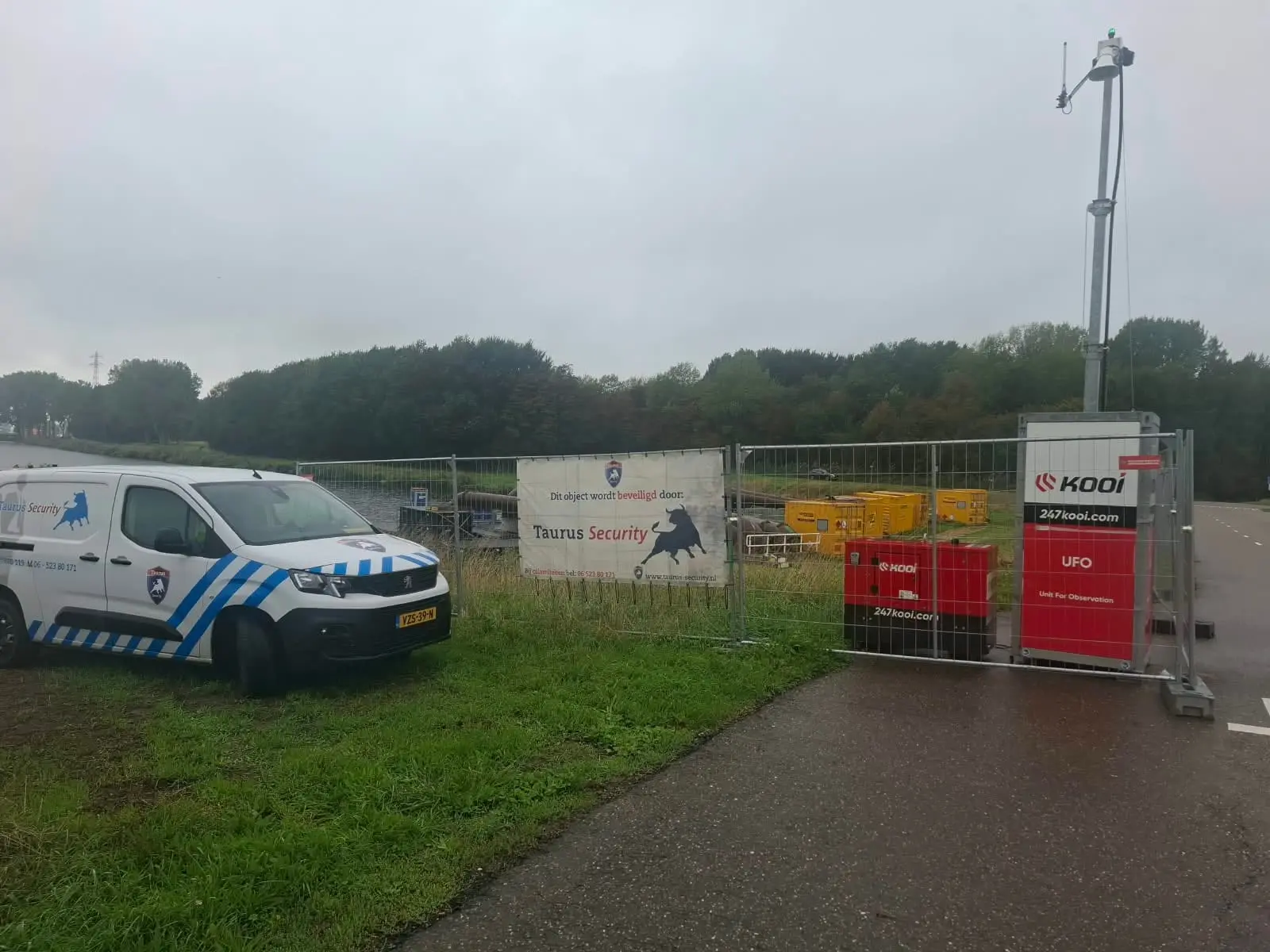
- At the moment itself
The unit detects movement
Remote operator
A mast-mounted camera registers movement in a zone that should be empty outside working hours.
- Relayed immediately
Footage reaches the monitoring centre
Remote operator
The images go straight through to a monitoring station. Someone is watching at the moment itself, rather than reviewing recordings afterwards.
- Typically within 1 minute
The operator assesses
Remote operator
A person looks at the footage and determines what is there. A fox, a branch in the wind and a rain shower all look the same to a detector as somebody climbing the fence.
- Closed within the same minute
False alarm, and done
Remote operator
If nothing is wrong, the detection is closed and logged. Nobody is sent and nobody is called. This accounts for the large majority of detections, which is exactly why the arrangement works.
- Straight after the assessment
Real detection, an officer attends
Officer on site
If the operator sees a person or vehicle that does not belong, an officer is dispatched. Where someone is caught in the act, the police attend alongside.
- Typically within 20 to 40 minutes
Checks on the site
Officer on site
On arrival the site is checked: whether anything has been taken, whether there is damage, whether plant has been left open. Where needed the site is secured again.
- Immediately on damage or theft
Site manager informed
You
In the event of damage or theft the site manager is called directly, so there is no unannounced stoppage in the morning. Every detection from that night appears in the overview.
What you get out of itThe site manager is not called out for every fox, but is called for every real detection. The next morning there is an overview of what was seen that night.
Response times are agreed per contract
The timings above reflect what is achieved in practice, not what we guarantee. What is set down for your site depends on distance, time of day and what has been agreed. That goes into the contract in writing, so you know where you stand.